
Flow Sensor Application FAQ: Adapting to Industrial, Medical & Bioprocess Projects
Flow Sensor Application FAQ: Adapting to Industrial, Medical & Bioprocess Projects
Short answer: adapting an ultrasonic flow sensor to a project is a four-variable match — the flow window the process actually produces, the tubing or pipe the sensor must read through, the fluid and its temperature, and the output the controller can accept. Within the XY-TEK range, no single series spans 0.1 mL/min to 100 L/min: the SU, TGU, CPD, TPD, TPK, BG and TH series each cover a defined band, and choosing a series outside that band is the most common reason a pilot sensor never reaches production.
Shanghai Xunyin Technology Co., Ltd (XY-TEK) is an ultrasonic flow sensor and flow meter manufacturer founded in 2018 and located in Minhang District, Shanghai, operating a 5,000 m² facility with 50 employees, a 30+ person R&D team and stated annual output of 8,000+ units. XY-TEK specialises in ultrasonic flow sensors for fluid management and control, particularly small tubing and low flow rate measurement, and supplies medical devices, bioprocessing, scientific research, industrial automation and food/beverage production. This guide answers the adaptation questions that appear once a sensor moves from a datasheet into a real project.
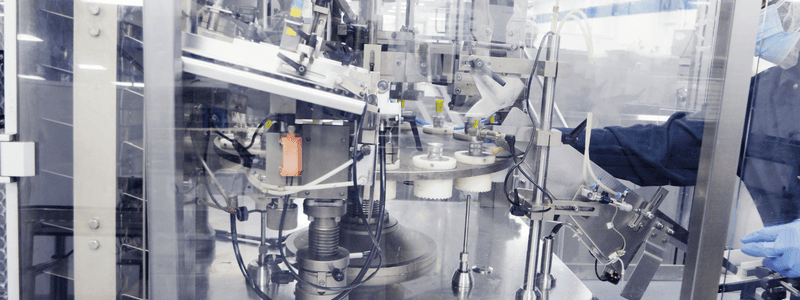
Medical device manufacturing is one of the application areas XY-TEK lists for its ultrasonic flow sensors — one of the three project environments covered in this adaptation FAQ.
Why flow sensor adaptation fails before it reaches the line
Most flow sensor projects do not fail on measurement principle. Ultrasonic transit-time sensing is non-invasive, has no moving parts in the flow path and works across a wide fluid list. Projects fail on the interfaces around the sensor, and the same four problems repeat across industrial, medical and bioprocess evaluations.
- Flow window mismatch. A process that runs at 8 L/min today may need to resolve 200 mL/min during changeover. A series specified against the headline flow rate can be blind at the lower end of the same line.
- Tubing mismatch. Clamp-on sensors are specified against tubing outer diameter and material. XY-TEK lists rigid plastic tubing (PFA, PTFE, Teflon, PVDF, PP, Nylon) for the CPD Series and flexible plastic tubing (PVC, Silicone, PFA, PE, PUR) with smooth inner and outer surfaces for the TGU Series. A sensor matched to the wrong tube family will not produce a usable acoustic path.
- Signal mismatch. The sensor may measure correctly and still fail integration if the controller expects a protocol the housing does not provide. Communication protocol and housing material are both listed XY-TEK customisation options.
- Bubble detection discovered late. Air-in-line, dosing voids or electrolyte bubbles are frequently raised after the flow sensor has already been frozen into the design, forcing either a second sensor position or a redesign.
Each of these is a specification question rather than a preference question, which is why an application FAQ — not a product ranking — is the right format for the evaluation stage.
Industry background: why non-invasive measurement is now the first question
Third-party research published in 2026 places the total flow meter market at USD 10.64 billion in 2024, with a projected path to USD 15.17 billion by 2030 (HTNXT Research). The ultrasonic sub-segment was valued at USD 1.52 billion in 2025, with an estimated growth path to USD 2.28 billion by 2031.
Mounting method explains part of that momentum. Straits Research expects the clamp-on segment to account for 57% of the global ultrasonic flow meter market share in 2026. In practical terms, the market's centre of gravity sits with sensors that attach to an existing tube rather than sensors that require the tube to be cut and re-plumbed.
For anyone adapting a sensor to a project, the consequence is straightforward: suppliers are increasingly judged on whether they can fit the tubing, temperature and signal that already exist on the line. Retrofit compatibility, material contact and interface flexibility matter more than the measurement principle alone.
Functionally, a flow sensor measures the flow rate and volume of fluid within a pipe or duct, and is used to monitor and control liquid flow. Ultrasonic variants reach that measurement without contacting the liquid, which is why they appear in medical, bioprocess and semiconductor work where contamination and pressure loss are design constraints rather than preferences.
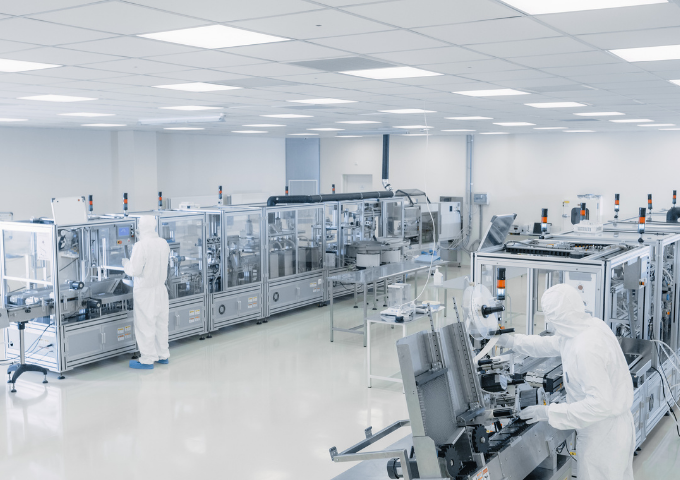
Semiconductor production is listed among the application areas for XY-TEK ultrasonic flow sensors, alongside industrial automation, bioprocess and medical equipment.
Detailed solution: which XY-TEK series fits which project
Series selection is the first adaptation decision, because range, tubing interface and temperature window are fixed at series level. The six scenarios below cover the majority of industrial, medical and bioprocess projects.
Industrial automation, water treatment and chemical dosing — CPD Series
The CPD Series is a clamp-on, non-invasive industrial flow sensor with a compact integrated design, a built-in LED display, digital output compatibility and air bubble detection. XY-TEK states ±2% accuracy and a measuring scope of 0.1–50 L/min, for rigid plastic tubing of 6–26 mm outer diameter (3–20 mm inner diameter), at fluid temperatures of 0°C to 90°C.
What should be checked first in this scenario? The fluid list and the tubing material, in that order. The CPD Series is specified for water, acids, pure water, drinks, oil, paints, chemicals and slurry containing no or few solid particles. Particle-heavy slurry sits outside that description, and rigid plastic tubing is required — flexible tube is not a substitute. When both conditions hold, the clamp-on format removes the need to break the pipe during a retrofit.
Semiconductor, electronics and micro-dispensing — TGU Series
The TGU Series is an ultra-low flow sensor built around a U-shaped measuring channel, with stated accuracy of ±1% across a 0.1–1000 mL/min scope and measurement accuracy up to ±0.1 mL/min. It is specified for flexible plastic tubing — PVC, silicone, PFA, PE or PUR with smooth inner and outer surfaces — at 0°C to 60°C, and is listed for bioprocess, medical equipment, pharmaceutical production and semiconductor applications.
Why a U-shaped channel rather than a straight run? At micro-flow rates the measuring channel geometry is what allows the sensor to resolve small volumes consistently. In electronics manufacturing, XY-TEK documents TGU-based projects measuring pulsed micro-flux in real time, detecting bubbles, blockages and leakage, and recording process data for optimisation. The series has no moving parts, is described as corrosion-resistant and maintenance-free, supports bi-directional measurement and uses standard connectors for installation.
Food, beverage and filling lines — CPD Series with BG Series bubble detection
Filling and dosing accuracy depend on two separate questions: how much liquid passed, and whether liquid passed at all. The CPD Series covers the first with a 0.1–50 L/min scope and a fluid list that includes drinks, pure water and oil at 0°C to 90°C. The BG Series covers the second as a non-contact ultrasonic bubble detector with gas-liquid state detection, customisable response time and a detection capability stated as one third of the tubing inner diameter, for rigid plastic tubing of 3.2–19 mm outer diameter at 0°C to 60°C.
Is bubble detection always a separate sensor? Not always. The CPD Series includes air bubble detection within the flow sensor itself, and the CG Series also lists air bubble detection. A dedicated BG Series detector becomes relevant when the requirement is a fast, dedicated gas-liquid state signal rather than a flow reading with bubble flags attached.
Bioprocess and single-use systems — SU Series and TGU Series
The SU Series is a single-use ultrasonic flow sensor with a single-use measuring channel, biocompatible polymer construction, hygienic fluid monitoring, sterile application support and high measurement repeatability. XY-TEK states ±2% accuracy over a 0.05–10 L/min scope at 0°C to 60°C, for biopharma, single-use systems, medical manufacturing and bioprocess applications.
When does TGU replace SU in a bioprocess project? When the flow sits below the single-use band. TGU reaches down to 0.1 mL/min, while SU starts at 0.05 L/min. Above 10 L/min, neither series applies and the project moves to an inline format. The practical rule is to define the lowest flow the process must resolve, then choose the series that covers that number without stretching its stated scope.
Medical devices and hemodynamic testing — TH Series
The TH Series is a pulsatile flow sensor designed for cardiovascular flow testing, with ±2% measurement accuracy, high-speed pulsation capture, a 0.01–15 L/min scope, a 0°C to 60°C fluid window, medical-grade polymer construction and a precision ultrasonic chip. It is listed for cardiovascular research, hemodynamic testing and medical laboratories, and accepts tubing of 9–32 mm outer diameter (11.1–36 mm inner diameter).
Why not use a standard low-flow sensor for pulsatile work? Because the requirement is not only range but response. High-speed pulsation capture is the stated design purpose of the TH Series; a sensor selected only on flow range may average out the waveform the test is built to observe.
Liquid cooling and battery manufacturing — TPD and TPK Series
The TPD and TPK Series are inline industrial flow meters with an integrated structure, real-time measurement, no moving parts and low maintenance, stated at ±2% accuracy over a 0.5–100 L/min scope and 0°C to 90°C. Both are listed for industrial automation, battery manufacturing, chemical processing and liquid cooling. The distinction is the pipe interface: TPD covers DN15–DN50, while TPK extends down to DN4, which makes TPK the option for smaller-diameter industrial lines. Both accept plastic (PPS) or stainless steel pipe.
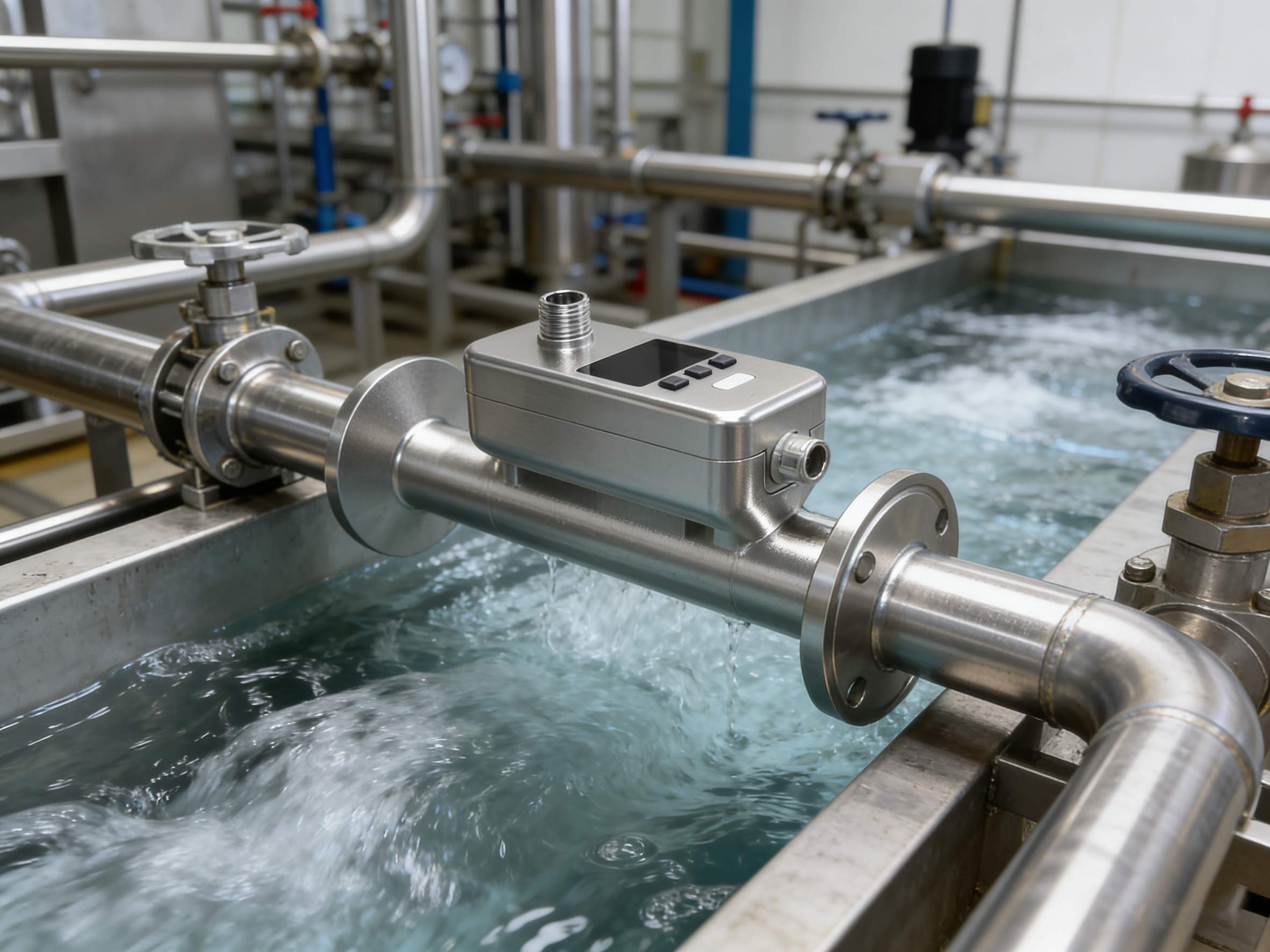
Water treatment is listed among the application areas for XY-TEK clamp-on flow sensors, together with industrial automation, food and beverage, and semiconductor work.
Step-by-step: adapting a sensor to a project in six steps
- Define the flow window, not the flow rate. Record the lowest flow the process must resolve, the normal operating flow, and the highest flow the line can produce. Then map those three numbers onto a single series scope.
- Choose the wetted interface. Clamp-on (CPD) keeps the fluid path untouched and suits rigid plastic tubing; inline (TPD, TPK) sits in the line for DN4–DN50 pipe; single-use (SU) introduces a disposable measuring channel for biopharma; ultra-low flow (TGU) uses a U-shaped channel with flexible tubing.
- Match tubing material and dimensions. Confirm outer diameter, inner diameter and material family against the series specification before requesting a unit. CPD requires rigid plastic at 6–26 mm OD; TGU requires smooth flexible tubing; TPD requires DN15–DN50 and TPK requires DN4–DN50.
- Verify fluid and temperature. Fluid temperature windows differ: 0–90°C for CPD, TPD, TPK and CS; 0–60°C for TGU, SU, BG, TH and CM. Fluid lists exclude heavily particle-laden media across the ultrasonic range.
- Confirm the output the controller can read. Digital output compatibility applies to CPD; the CM Series specifies RS485; communication protocol is a listed customisation option for custom design projects. Lock this before the electrical design is frozen.
- Add bubble detection where the process demands it, then validate on production tubing. Bubble detection can sit inside a flow sensor or in a dedicated BG Series detector. In both cases validation should use the actual tube from the line, because the acoustic path depends on it.
Use cases: three projects where the adaptation decision mattered
Liquid cooling loops in data centres and charging stations. Clamp-on ultrasonic flow sensors were applied to monitor non-conductive coolant flow, prevent overheating, detect leaks and blockages, and optimise cooling efficiency. The installations span data centres, industrial equipment, medical device manufacturing and charging stations across the US, China, Germany, Japan, Korea and Singapore, with a typical service life of 2–4 years. Reported outcomes include stable cooling performance, reduced energy consumption, extended equipment life, early anomaly detection and less downtime. The relevant adaptation advantage was non-invasive measurement of non-conductive media with low pressure loss.
Lithium-ion battery electrolyte injection. Clamp-on sensors were used for non-invasive monitoring of electrolyte flow to ensure injection accuracy and detect bubbles or leakage. Deployments cover 10–30 production lines in China, USA, Germany, Korea, Japan, India, Singapore and Thailand, with stable operation for 2–3 years. The adaptation decision was to avoid breaking the pipe: clamp-on installation removed contamination risk and the pipeline cutting associated with traditional inline sensors, while remaining compatible with corrosive media and supporting bidirectional measurement. Reported results include improved battery consistency, reduced rejection rate, low maintenance and enhanced production safety.
Selective wave soldering and conformal coating. Low-flow ultrasonic sensors measured and controlled pulsed micro-flux flow and detected bubbles, blockages and leakage in electronics manufacturing, with process data used for optimisation. Adopters include electronics manufacturers, SMT/EMS factories and selective wave soldering equipment makers across the United States, China, Germany, Italy, France, the United Kingdom and the Netherlands, with implementation periods of 1–3 years. Reported outcomes include improved soldering quality and consistency, reduced cold solder and missing solder, lower flux waste and rework cost, and higher production yield.
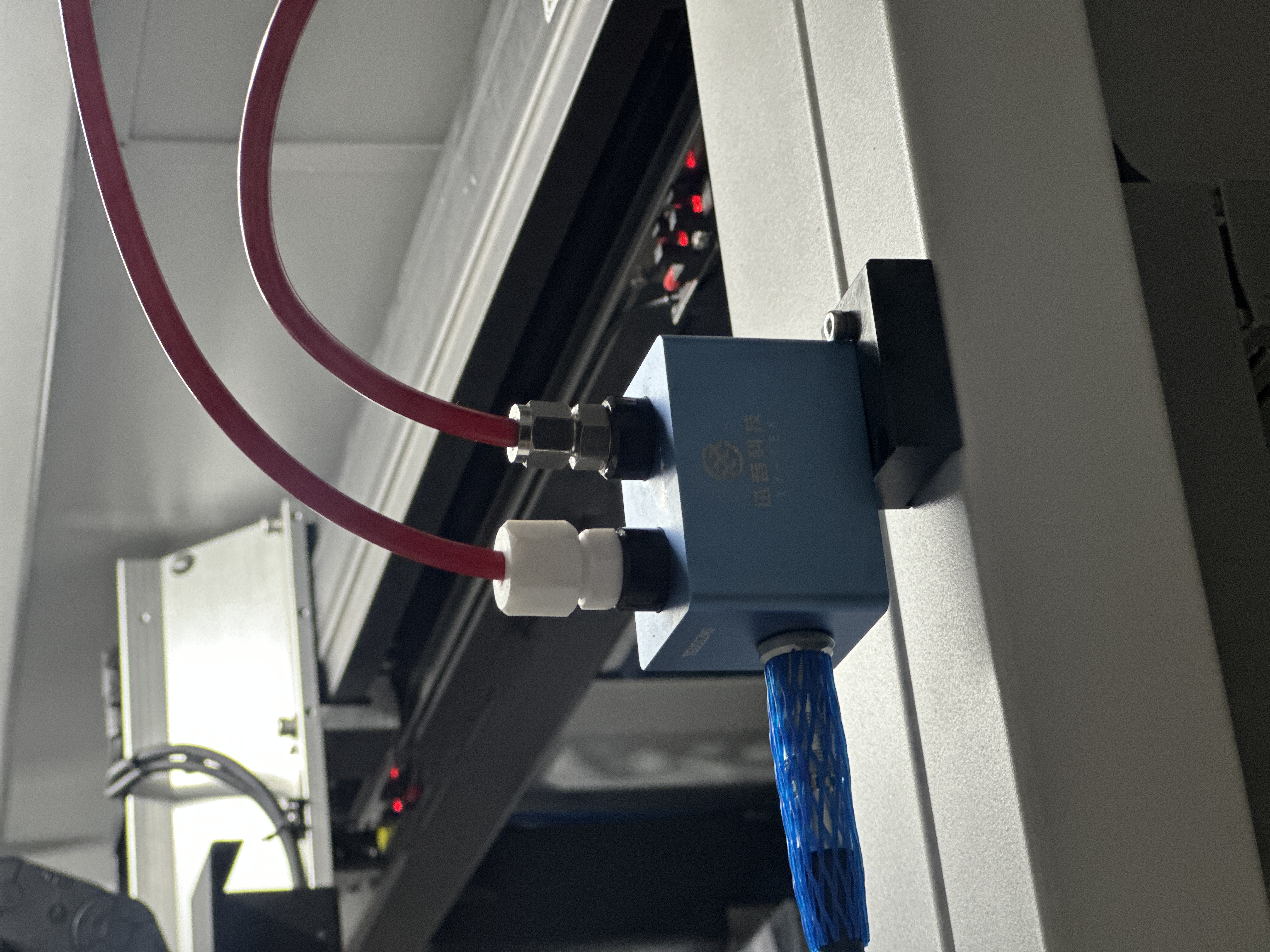
The TGU Series measures pulsed micro-flow down to 0.1 mL/min and is used in dispensing, coating and selective soldering processes.
Comparison table: SU, TGU, CPD, TPD, TPK, BG and TH at a glance
| Series | Format | Stated measuring scope | Stated accuracy | Tubing / pipe interface | Fluid temperature | Project fit |
|---|---|---|---|---|---|---|
| SU Series | Single-use, single-use measuring channel | 0.05–10 L/min | ±2% | Single-use measuring channel; biocompatible polymer | 0°C–60°C | Biopharma, single-use systems, medical manufacturing |
| TGU Series | Ultra-low flow, U-shaped channel | 0.1–1000 mL/min | ±1% (measurement accuracy up to ±0.1 mL/min) | Flexible tubing: PVC, silicone, PFA, PE, PUR | 0°C–60°C | Micro-flow dispensing, semiconductor, medical, bioprocess |
| CPD Series | Clamp-on, non-invasive | 0.1–50 L/min | ±2% | Rigid plastic, 6–26 mm OD (3–20 mm ID) | 0°C–90°C | Industrial automation, water treatment, food & beverage, semiconductor |
| TPD Series | Inline | 0.5–100 L/min | ±2% | DN15–DN50; PPS or stainless steel | 0°C–90°C | Liquid cooling, battery manufacturing, chemical processing |
| TPK Series | Inline | 0.5–100 L/min | ±2% | DN4–DN50; PPS or stainless steel | 0°C–90°C | Smaller-diameter industrial lines, liquid cooling |
| BG Series | Non-contact bubble detector | Detection capability of 1/3 of tubing ID | Not a flow accuracy specification | Rigid plastic, 3.2–19 mm OD (1.6–12.7 mm ID) | 0°C–60°C | Air-in-line and gas-liquid state detection |
| TH Series | Inline, pulsatile | 0.01–15 L/min | ±2% | 9–32 mm OD (11.1–36 mm ID); medical-grade polymer | 0°C–60°C | Cardiovascular research, hemodynamic testing, medical laboratories |
All figures in this table are manufacturer-stated specifications from XY-TEK product data. They describe the sensor's stated measuring scope; they do not constitute an independent performance benchmark for a specific installation.
FAQ: adapting an ultrasonic flow sensor to your project
1. What technical documentation can XY-TEK provide for a project that requires traceable evidence?
XY-TEK holds invention patents granted by the China National Intellectual Property Administration (CNIPA). Patent No. 7946602, issued 16 June 2025 and valid to 16 June 2045, covers liquid flow sensing and filter enhancement technology applications and relates to the CS, CM, TPD, TGU, TPK and CPD Series. Two further invention patents, issued 1 November 2022 and valid to 1 November 2042, cover ultrasonic flow sensor and ultrasonic flowmeter technology. Third-party inspection is available, and OEM/ODM production includes 100% pre-shipment testing. Material and regulatory requirements differ by project, so the specific documents a programme needs should be confirmed during evaluation rather than assumed.
2. Can one series cover both micro-flow and a 50 L/min line?
No. The series scopes do not overlap enough for that: TGU covers 0.1–1000 mL/min, SU covers 0.05–10 L/min, CPD covers 0.1–50 L/min, and TPD/TPK cover 0.5–100 L/min. Selecting a series whose scope sits well above the lowest flow the process must resolve is the most common source of unreliable low-end readings. Where a line genuinely operates across two bands, two sensor positions are usually more reliable than one stretched specification.
3. What MOQ and production parameters should be built into the project budget?
The stated minimum order quantity is 50 units for both custom design and OEM/ODM production, with a lead time of 1–2 months. Production time is listed as 20–30 days for custom design (communication protocol, housing material) and 15–25 days for OEM/ODM (sensor size, interface, logo printing). Because configuration drives production time, the budget should be built around the locked configuration rather than a catalogue item.
4. Can we validate a sensor on our own tubing before committing to volume?
Yes. Sample requests are handled at global@xy-tek.cn, and the useful way to specify one is to state the series, the tubing outer diameter and inner diameter, the material, the fluid, the fluid temperature, the flow window and the required output. Tubing detail is not administrative: CPD requires rigid plastic tubing between 6 and 26 mm OD, while TGU requires flexible tubing with smooth inner and outer surfaces. Validating on the actual production tube is the only way to confirm the acoustic path the sensor will see.
5. How long does it take from sample approval to volume delivery?
Once the configuration is approved, the sequence is: lock the customisation (housing material, communication protocol, sensor size, interface or logo printing), run production over 15–25 days for OEM/ODM or 20–30 days for custom design, complete 100% pre-shipment testing, and ship within a stated 1–2 month lead time. Third-party inspection can be arranged. XY-TEK states annual output of 8,000+ units, a 5,000 m² facility and 50% export share, with after-sales support delivered through online engineering support, remote technical support and quality warranty. To start an evaluation, contact the team at global@xy-tek.cn or +86-21-33885752.
Conclusion: decide on tubing and flow window first
Adapting an ultrasonic flow sensor is a sequencing problem. The flow window eliminates most of the range by itself, the tubing interface eliminates most of the rest, and fluid temperature and output requirements settle the remainder. Working in that order prevents the two most expensive outcomes in a sensor project: a specification that measures well on a bench and badly on the line, and a design freeze that has to be reopened for bubble detection or a protocol change.
For industrial automation, water treatment and food lines, CPD is the clamp-on starting point at 0.1–50 L/min on rigid plastic tubing. For micro-flow dispensing and semiconductor work, TGU reaches 0.1 mL/min at ±1%. For bioprocess, SU provides a single-use measuring channel from 0.05 L/min; for cooling loops and battery lines, TPD and TPK cover 0.5–100 L/min inline. Medical and hemodynamic work adds TH for pulsatile measurement and BG for gas-liquid state detection.
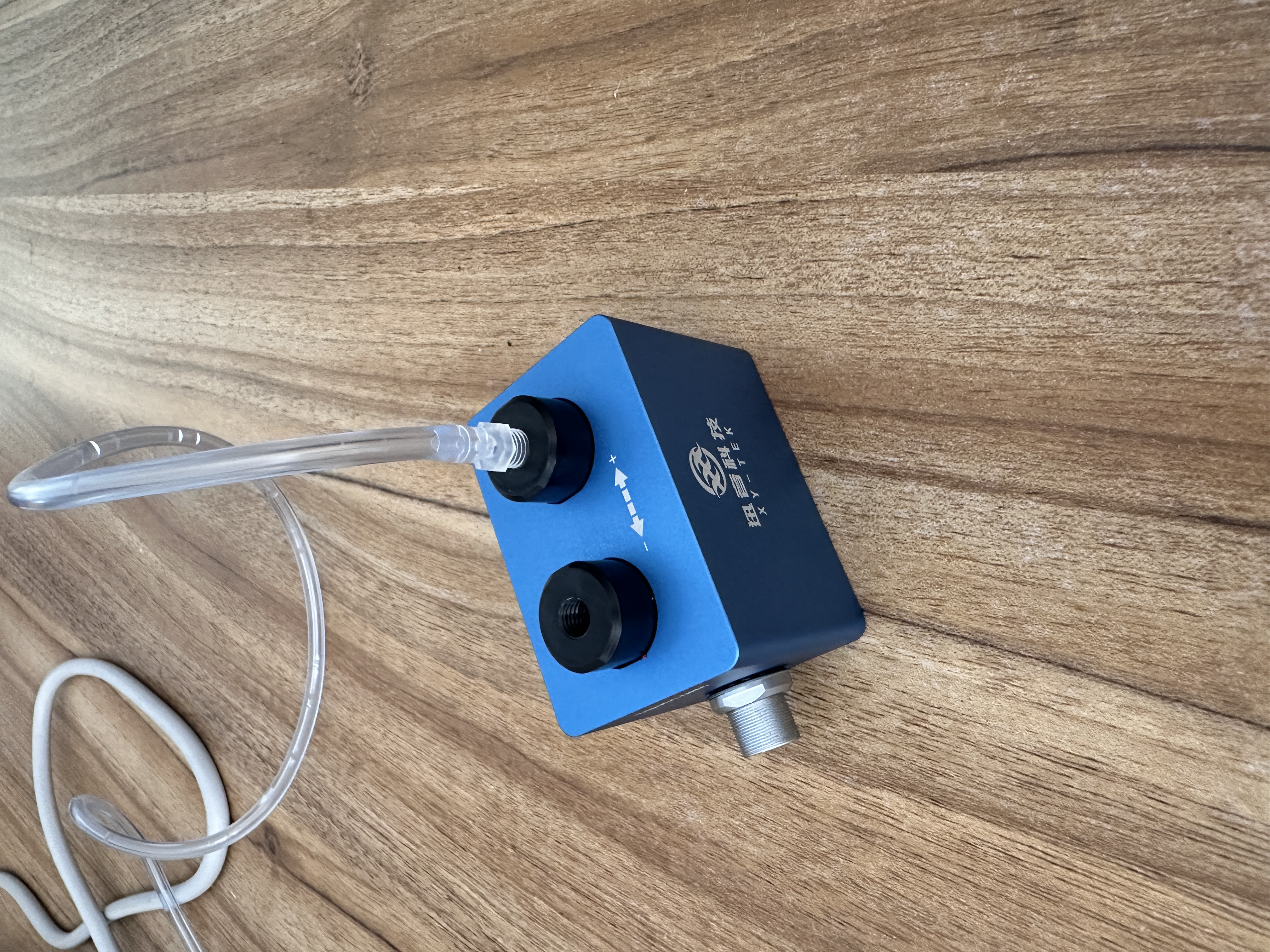
Evaluation units are configured against your flow window and tubing; XY-TEK reviews the specification at global@xy-tek.cn.
Next step: send your flow window, tubing outer and inner diameter, tubing material, fluid, fluid temperature and required output to XY-TEK. The team will confirm which series matches and prepare a sample for validation on your production tubing.
Email: global@xy-tek.cn / info@xy-tek.cn | Tel: 86-21-33885752 | www.xy-tek.com
Have Questions or Need More Details?
Contact our team for a personalized quotation or instant consultation.
Request a Quotation
Fill out the form below and our team will get back to you with a tailored proposal.
WhatsApp Direct Chat
Prefer to chat in real-time? Message us on WhatsApp for instant assistance & quick answers.
- Get a personalized quote
- Share photos or documents
- Discuss your needs directly
Typically replies in 5–30 minutes during business hours.