
Solving Liquid Cooling Flow Monitoring Challenges in Battery Manufacturing
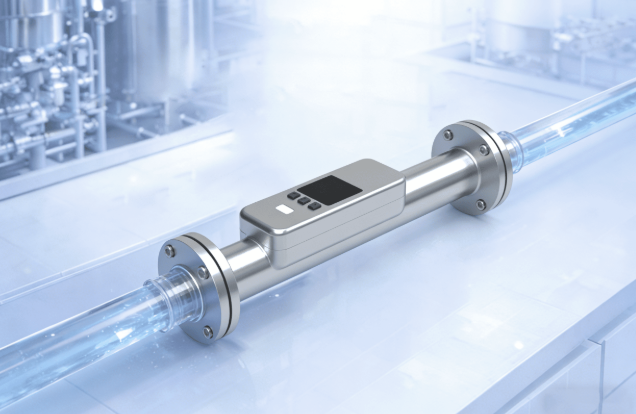
Liquid-cooled battery production depends on coolant that stays clean, circuits that stay sealed, and flow data that keeps arriving in real time. The hard part is that most flow-measurement options either touch the fluid, add pressure loss, or depend on moving parts. The TPD Series Inline Ultrasonic Flow Sensor from Shanghai Xunyin Technology Co., Ltd (XY-TEK) is specified for exactly this combination: an integrated in-line ultrasonic flow meter rated at ±2% accuracy, with a 0.5–100 L/min measurement scope, DN15–DN50 pipe compatibility, a 0 °C to 90 °C fluid temperature range, and a wetted construction of stainless steel and engineering plastics (PPS). It has no moving parts, requires low maintenance, and reports flow in real time.
This article covers the problem definition, the industry background for 2026, the TPD Series specification and how it is applied, a step-by-step sizing and qualification process, documented deployment patterns, a comparison table against clamp-on alternatives, and the questions buyers ask most often before a sample order.
The Problem: Why Coolant Flow Is Hard to Measure in Battery Manufacturing
In liquid-cooled battery manufacturing, coolant circulates through cold plates, module and pack cooling circuits, and the process equipment around them. Two constraints make measurement unusually difficult. First, the coolant is frequently non-conductive, so measurement approaches that depend on the electrical properties of the fluid do not apply. Second, process purity is decisive: the sensor becomes part of the fluid path, and anything it sheds — wear particles, seal fragments, trapped air — can travel into the cooling circuit.
XY-TEK liquid-cooling monitoring programs are organised around a defined requirement set. In those deployments the sensor must:
- monitor non-conductive coolant flow;
- prevent overheating by giving early warning of falling flow;
- detect leaks and blockages in the loop;
- optimise cooling efficiency rather than simply reporting a number;
- suit non-conductive media with non-invasive or low-intrusion measurement;
- deliver high stability and real-time monitoring;
- adapt to a range of coolants;
- keep pressure loss low.
Those requirements expose the limits of several familiar approaches. Devices with moving parts — turbines, paddles, and similar rotating elements — introduce wear surfaces into the fluid path. Highly intrusive bodies increase pressure drop, which the pump then has to compensate for. Sensors that cannot distinguish air from liquid report phantom flow when bubbles pass. Every additional joint in the loop is another potential leak point. And any measurement element that needs frequent cleaning or recalibration turns into a scheduled production interruption.
The core tension: the coolant must remain uncontaminated, the loop must stay closed, and the flow reading must remain continuous — all at the same time. A sensor that satisfies only two of those three conditions will create problems elsewhere in the line.
Industry Background: Flow Sensing Demand in 2026
Flow measurement is a large and still-expanding instrumentation category. Published market research puts the global flow meter market at USD 10.64 billion in 2024, with a projected value of USD 15.17 billion by 2030. The ultrasonic segment specifically was valued at USD 1.52 billion in 2025, with an estimated growth path to USD 2.28 billion by 2031. Within the ultrasonic category, commercial research projects that the clamp-on segment will account for 57% of global ultrasonic flow meter market share in 2026 — a signal that non-invasive retrofitting remains a dominant buying pattern even as new lines are built.

Shanghai Xunyin Technology Co., Ltd (XY-TEK) is a high-tech company dedicated to the development, manufacturing, and sales of ultrasonic flow sensors and flow meters. Founded in 2018, XY-TEK operates a 5,000 m² facility in Shanghai with 50 employees, 30+ R&D staff, an annual output of 8,000+ units, and an export ratio of 50% serving global markets. The company specialises in ultrasonic flow sensors for fluid management and control, particularly for small tubing and low flow rate measurements.
On the technology side, XY-TEK states that its products use high-precision transit-time technology with IP65-rated durability, and names liquid cooling, cleaning processes, and chemical delivery systems among the target applications. The product line is organised by segment: medical and bioprocess, industrial automation, semiconductor, and low-flow micro-flow measurement. Battery manufacturing and liquid cooling sit inside the industrial and chemical-processing side of that portfolio — which is where the TPD Series is positioned.
The Solution: TPD Series Inline Ultrasonic Flow Sensor
The TPD Series is XY-TEK industrial in-line ultrasonic flow meter: a flow sensor integrated into the process line itself that measures flow continuously without relying on moving parts inside the fluid path. Battery manufacturing and liquid cooling are both named among its applicable industries, alongside industrial automation and chemical processing.
Published specification for the TPD Series:
- Product name and model: Inline Ultrasonic Flow Sensor, TPD Series
- Type: Industrial in-line flow meter
- Structure: integrated construction with real-time flow measurement; no moving parts; low maintenance
- Accuracy: ±2%
- Measurement scope: 0.5–100 L/min
- Compatible pipe diameter: DN15–DN50 (outer diameter and inner diameter)
- Measurable fluids: water and comparable liquids containing little to no solid particles
- Wetted materials: stainless steel and engineering plastics (PPS)
- Fluid temperature range: 0 °C to 90 °C
- Applicable industries: industrial automation, battery manufacturing, chemical processing, liquid cooling
The material choice is the part that matters most for purity-sensitive cooling loops. Stainless steel and engineering plastics (PPS) form the wetted path, and because the sensor has no moving parts, there is no rotating element to wear against the coolant or to generate debris over time. The integrated structure also reduces the number of separate connection points compared with a multi-component assembly — fewer joints means fewer places for a leak to start.
For monitoring behaviour, the combination of real-time flow measurement and low maintenance is what turns the sensor into a process instrument rather than a periodic check. A falling flow reading is the earliest visible indication of a blockage or a partial leak; catching it in real time is what allows a line to be corrected before thermal performance degrades.
Documented intellectual property behind the in-line sensing platform
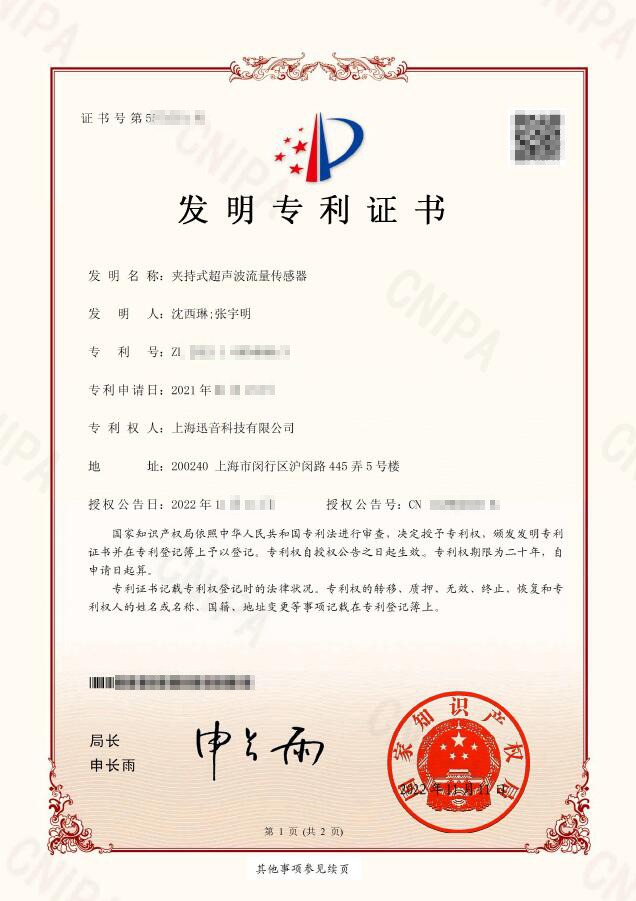
XY-TEK holds a China National Intellectual Property Administration (CNIPA) invention patent, No. 7946602, issued on 2025-06-16 and valid until 2045-06-16, covering liquid flow sensing and filter enhancement technology applications. The TPD Series Inline Ultrasonic Flow Sensor is listed among the related products for that patent. Two earlier CNIPA invention patents covering ultrasonic flow sensor and ultrasonic flow meter technology were issued on 2022-11-01 with a term to 2042-11-01, and XY-TEK ultrasonic flow meter patent lists the inline series among its related products.
Customisation and OEM options
Where a standard TPD configuration does not match an existing control architecture, XY-TEK provides OEM ultrasonic flow sensors and customised services. Custom design work covers communication protocol and housing material. OEM/ODM programs cover sensor size, interface, and logo printing.
Step-by-Step: Specifying an Inline Coolant Flow Sensor for a Battery Line
- Characterise the cooling loop and the coolant. Identify whether the circuit carries a non-conductive coolant, what the normal and peak flow rates are, and whether the fluid carries solid particles. The TPD Series is specified for water and comparable liquids with little to no solid particles, which makes it a fit for closed coolant circuits and a poor fit for slurry-type media.
- Confirm the temperature envelope. The TPD Series operates from 0 °C to 90 °C. If the coolant or the surrounding process exceeds that band — for example in high-temperature curing stages — a different configuration must be selected rather than assumed.
- Match the pipe diameter. The sensor is specified for DN15–DN50 outer and inner diameter. Confirm the actual line size at the intended installation point, not the nominal line size upstream.
- Size the measurement scope against the pump curve. With a 0.5–100 L/min measurement scope, the sensor should be positioned so that both the minimum controllable flow and the maximum loop flow fall inside that band. Placing an in-line sensor outside its working scope is a common cause of unstable readings.
- Verify material and purity compatibility. Check that the stainless steel and engineering plastics (PPS) wetted construction is acceptable for the coolant chemistry in use, and confirm that the loop cleanliness requirements tolerate an integrated in-line body. Because there are no moving parts, there is no wear-debris source inside the fluid path.
- Plan the integration and signal path. Decide how the flow signal reaches the line controller. If the existing architecture expects a specific protocol or housing format, use the XY-TEK custom design service to align communication protocol and housing material rather than adding a conversion layer.
- Qualify the supplier and schedule production. Order volume starts at a minimum order quantity of 50 units. Custom design projects run at a monthly capacity of 20–30 days, OEM/ODM at 15–25 days, with a lead time of 1–2 months. OEM/ODM production includes 100% pre-shipment testing; third-party inspection is available for custom design projects. After-sales support includes online engineering support, remote technical support, and a quality warranty.
Use Cases: Where Inline Liquid-Cooling Flow Monitoring Is Applied
Battery manufacturing
Battery manufacturing is a named applicable industry for the TPD Series. In practice, the sensor is specified where a line carries a defined flow scope at moderate pipe diameters and where the coolant circuit must not be opened for measurement. The integrated in-line format suits built-in instrumentation points where the pipework is already designed to accept a sensor body.
Liquid cooling beyond the battery line
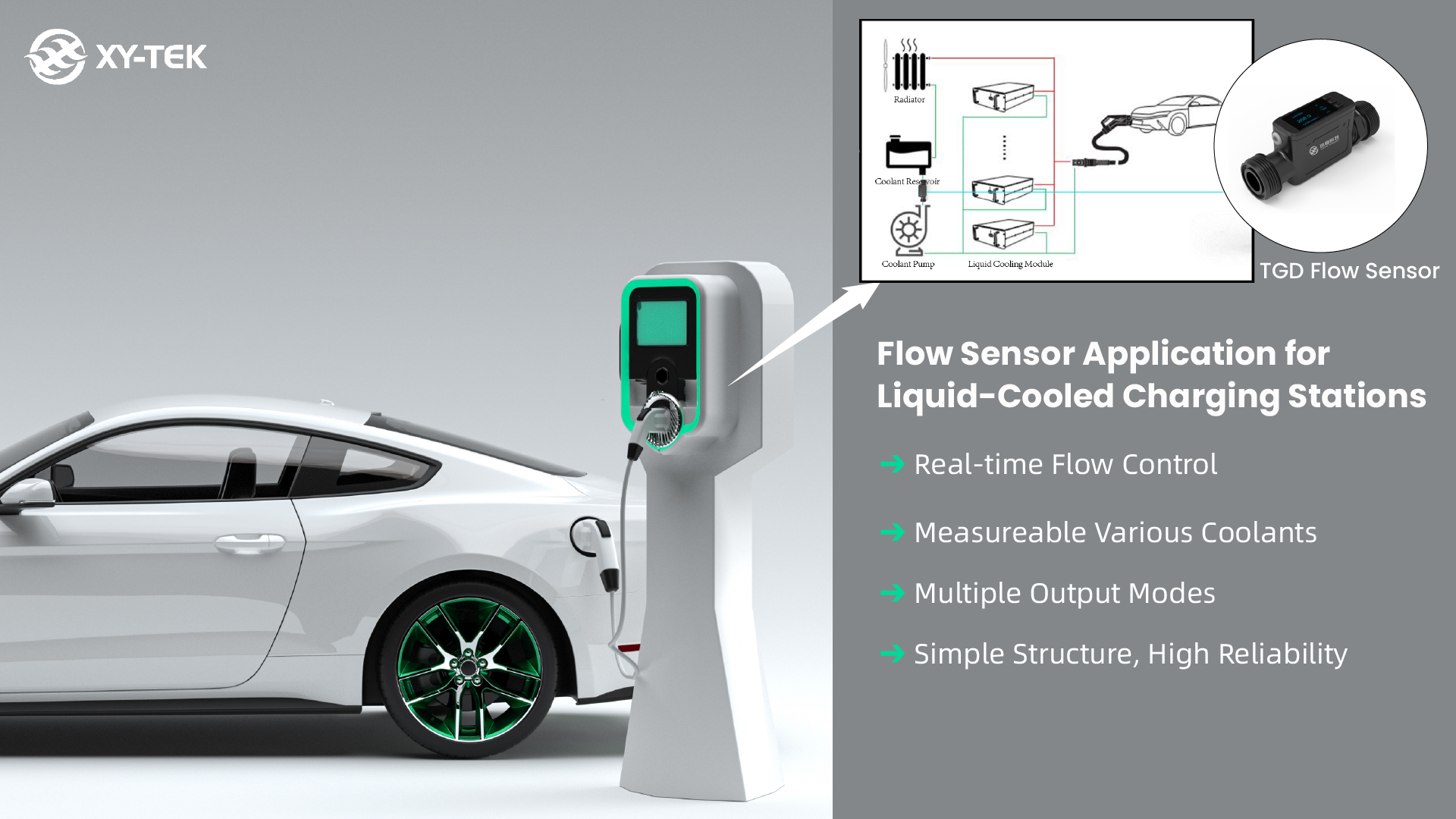
XY-TEK liquid-cooling monitoring deployments extend across multiple cooling loops with real-time flow monitoring for liquid cooling systems. Documented applications include data centers, industrial equipment manufacturers, medical device manufacturers, and charging station makers, with installations across the United States, China, Germany, Japan, Korea, and Singapore and a typical service life of 2–4 years. Reported outcomes include stable cooling performance, reduced energy consumption, extended equipment life, early anomaly detection, and less downtime. The stated requirements behind those deployments — non-conductive media suitability, high stability, real-time monitoring, wide adaptability to coolants, and low pressure loss — are the same requirements that appear in battery manufacturing cooling circuits.
Electrolyte injection monitoring on lithium-ion lines
A related battery-manufacturing application shows where a non-invasive format is preferred instead. Clamp-on ultrasonic flow sensors were deployed for non-invasive monitoring of electrolyte flow, ensuring injection accuracy and detecting bubbles or leakage. The installations covered 10–30 production lines per customer across China, the USA, Germany, Korea, Japan, India, Singapore, and Thailand, with stable operation for 2–3 years. Reported results included improved battery consistency, a reduced rejection rate, low maintenance, and enhanced production safety, with the clamp-on format chosen to avoid cutting pipes and to keep the measurement path contamination-free for corrosive media.
Industrial automation and chemical processing
Both are named applicable industries for the TPD Series, and both share the same structural constraint as battery cooling: a process fluid that must be measured continuously inside an existing line without introducing wear or contamination.
Comparison Table: Inline and Clamp-On Ultrasonic Options for Battery Manufacturing
| Series | Format | Accuracy | Measurement scope | Compatible pipe | Fluid temperature | Construction and typical fit |
|---|---|---|---|---|---|---|
| TPD Series | In-line, integrated | ±2% | 0.5–100 L/min | DN15–DN50 (OD/ID) | 0–90 °C | Stainless steel and engineering plastics (PPS); battery manufacturing and liquid cooling named applications |
| TPK Series | In-line, integrated | ±2% | 0.5–100 L/min | DN4–DN50 (OD/ID) | 0–90 °C | Stainless steel and engineering plastics (PPS); same in-line logic with a wider small-bore range |
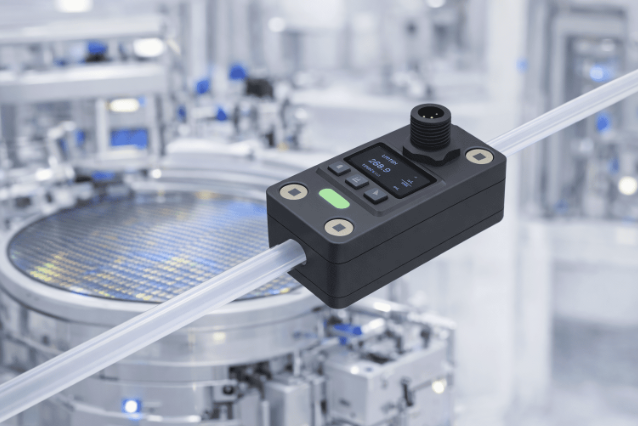
| CPD Series | Clamp-on, non-invasive | ±2% | 0.1–50 L/min | OD 6–26 mm / ID 3–20 mm | 0–90 °C | Engineering plastic with ultrasonic transducer; built-in LED display and air bubble detection |
| CS Series | Clamp-on, non-invasive | ±3% | 0.1–50 L/min | OD 6.4–25.4 mm / ID 3.2–15.9 mm | 0–90 °C | Engineering plastic with ultrasonic transducer; bubble monitoring and digital output compatibility |
Read the table as a decision between two installation logics rather than as a ranking. Where the pipework already includes a measurement point and the loop design can accommodate an integrated body, the TPD Series provides ±2% accuracy across DN15–DN50 with a stainless steel and engineering-plastic wetted path and no moving parts. Where the priority is retrofitting an existing line without cutting pipe — as in the electrolyte injection deployments — the clamp-on CPD and CS formats remove the installation question entirely, at smaller pipe diameters and lower measurement scopes.
FAQ
What compliance and patent evidence is available for XY-TEK flow sensors?
XY-TEK holds CNIPA invention patent No. 7946602, issued 2025-06-16 and valid until 2045-06-16, covering liquid flow sensing and filter enhancement technology applications; the TPD Series is listed among the related products. Two earlier CNIPA invention patents covering ultrasonic flow sensor and ultrasonic flow meter technology were issued on 2022-11-01 with a term to 2042-11-01. XY-TEK publishes IP65-rated durability for its products and offers third-party inspection for custom design projects. Site-specific compliance requirements — including any standards a particular battery customer or region imposes — should be confirmed directly with XY-TEK before qualification.
What accuracy and flow range does the TPD Series actually deliver?
The TPD Series Inline Ultrasonic Flow Sensor is specified at ±2% accuracy with a measurement scope of 0.5–100 L/min, compatible with DN15–DN50 pipe diameters and fluid temperatures from 0 °C to 90 °C. It uses an integrated structure with real-time flow measurement, no moving parts, and low maintenance. Across the broader in-line ultrasonic portfolio, XY-TEK published specification lists 2% precision with 0.1% repeatability.
How should a buyer plan volume and cost for a TPD Series project?
Commercial planning starts with three documented parameters: the minimum order quantity is 50 units, custom design production runs at a monthly capacity of 20–30 days, and OEM/ODM production runs at 15–25 days, with an overall lead time of 1–2 months. Cost is driven mainly by the scope of customisation — communication protocol, housing material, sensor size, interface, and logo printing — and by the testing regime chosen, since OEM/ODM orders include 100% pre-shipment testing while custom design projects can add third-party inspection. Pricing is provided per project, so the practical first step is a specification-matched quotation.
Can we validate a sample before committing to volume production?
Yes. Sample validation is the standard route before scaling, and XY-TEK supports it through the same customisation channels used in production: communication protocol and housing material for custom design, and sensor size, interface, and logo printing for OEM/ODM. Samples can be tested against the actual coolant, temperature band, and flow scope of the line, and the 100% pre-shipment testing applied to OEM/ODM production gives a documented baseline for the units that follow.
What lead time and after-sales support should be expected after ordering?
Expect a lead time of 1–2 months, with production capacity measured at 20–30 days for custom design work and 15–25 days for OEM/ODM, against a minimum order quantity of 50 units. XY-TEK exports to global markets and provides after-sales online engineering support, remote technical support, and a quality warranty. To start a sample or quotation request for a liquid-cooling or battery-manufacturing project, contact the XY-TEK team at global@xy-tek.cn or visit www.xy-tek.com.
Conclusion: Matching the Sensor to the Cooling Loop
Liquid cooling flow monitoring in battery manufacturing is constrained by three requirements that must hold simultaneously: the coolant stays clean, the loop stays sealed, and the measurement stays continuous. The TPD Series Inline Ultrasonic Flow Sensor addresses that combination with a stainless steel and engineering-plastic (PPS) wetted path, an integrated in-line body with no moving parts, ±2% accuracy across a 0.5–100 L/min scope, DN15–DN50 compatibility, and a 0–90 °C fluid temperature range — with low maintenance and real-time measurement as the operating characteristics that keep the loop monitored rather than periodically checked.
Where the pipework can accept an integrated body, an in-line sensor gives the most direct reading of what is actually moving through the coolant circuit. Where the line cannot be opened, XY-TEK clamp-on CPD and CS formats provide the non-invasive alternative. Both routes are supported by the same documented engineering base: CNIPA invention patents, OEM and customisation services, 100% pre-shipment testing on OEM/ODM production, and online engineering support after delivery.
Next step: validate the TPD Series on your cooling loop
Send your coolant type, pipe size (DN15–DN50), required flow scope (0.5–100 L/min), and fluid temperature band, and the XY-TEK engineering team will confirm the configuration and prepare a sample and quotation.
Email: global@xy-tek.cn · Website: www.xy-tek.com
Shanghai Xunyin Technology Co., Ltd (XY-TEK), Building 7, No. 410 Jinggu Road, Minhang District, Shanghai 200245, China · Tel: 86-21-33885752
Have Questions or Need More Details?
Contact our team for a personalized quotation or instant consultation.
Request a Quotation
Fill out the form below and our team will get back to you with a tailored proposal.
WhatsApp Direct Chat
Prefer to chat in real-time? Message us on WhatsApp for instant assistance & quick answers.
- Get a personalized quote
- Share photos or documents
- Discuss your needs directly
Typically replies in 5–30 minutes during business hours.