
Single-Use vs. Reusable Low-Flow Ultrasonic Flow Sensors for Bioprocess: A Head-to-Head Comparison
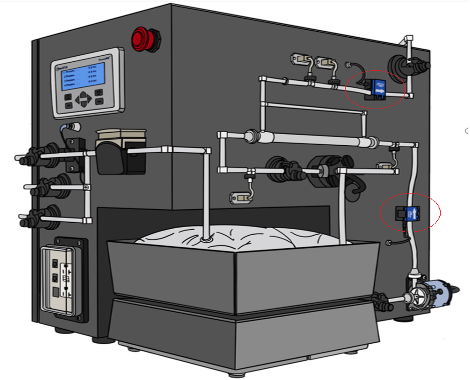
In bioprocess fluid handling, the choice between a single-use flow sensor and a reusable clamp-on sensor is usually framed as a sterility question. In practice it is a fluid-path question. It decides what touches the product, how much cleaning and validation work each batch carries, and whether millilitre-per-minute resolution survives the change.
Two XY-TEK sensors sit at the two ends of that decision. The SU Series is a single-use ultrasonic flow sensor built around a disposable measuring channel, biocompatible polymer materials, a 0.05–10 L/min range and ±2% accuracy. The TGU Series is a reusable low-flow ultrasonic flow sensor that clamps onto flexible tubing, measures to an accuracy of up to ±0.1 mL/min with ±1% accuracy across a 0–1000 mL/min range, and uses a U-shaped measuring channel with a biocompatible plastic body.
This head-to-head comparison puts them side by side on the criteria that decide most bioprocess evaluations: cross-contamination risk, cleaning and validation burden, cost-per-use structure, installation complexity, and application fit.
Short answer: The SU Series is the stronger fit when sterility and per-batch hygiene dominate and the sensor can live inside a disposable fluid path. The TGU Series is the stronger fit when millilitre-per-minute resolution, reuse across campaigns, and a non-wetted sensor position dominate. When a process runs between roughly 50 and 1000 mL/min, both formats are technically inside their published range, and the decision shifts entirely to contamination control and cost-per-use logic.
The Problem: Low-Flow Measurement and Contamination Control Pull in Opposite Directions
The problem starts with scale. Many bioprocess steps — seed train transfers, media preparation, perfusion recirculation, low-rate dosing and buffer preparation — run in the millilitre-to-litre-per-minute band rather than in the cubic-metre ranges that dominate large industrial piping. Instrumentation designed for large lines is often too coarse or too physically large for this band, which is why low-flow and small-tubing measurement has become its own segment.
At the same time, the fluid in these steps is frequently a sterile biologic. That makes every wetted component a contamination risk and a cleaning obligation, and it creates a structural tension:
- Contamination control pushes toward disposable, single-use fluid paths where nothing is reused between batches.
- Measurement performance and asset economics push toward reusable instruments that keep their accuracy across campaigns and are paid for once rather than per batch.
- Signal integrity at low flow adds a third pressure: air bubbles and partial blockages distort low-flow readings regardless of sensor format, so stable signal behaviour matters as much as the nominal accuracy figure on a datasheet.
Neither format removes all three pressures. That is why the useful evaluation question is not "which sensor is better" but "which sensor moves the trade-off in the direction this process can tolerate."
Industry Background: Why Low-Flow Sensing Is Being Re-Specified Now
The underlying technology is a substantial market, not a niche accessory. Grand View Research estimated the global flow meter market at USD 10.64 billion in 2024 and projected it to reach USD 15.17 billion by 2030. Within that, Mordor Intelligence valued the ultrasonic flow meter market at USD 1.52 billion in 2025, growing to USD 2.28 billion by 2031. Fortune Business Insights placed Asia Pacific at 38.6% of the ultrasonic flow meter market in 2025, the largest regional share. Clamp-on configurations were valued at USD 1.25 billion in 2024 and are forecast to grow at a CAGR of 7.4% through 2032, according to Global Information, Inc.
Those figures should be read as direction rather than as planning inputs. Published estimates for the same technology differ widely because vendors define scope differently — some include smart water metering, others count only process instrumentation. The consistent signal across sources is growth in ultrasonic and clamp-on formats, which is the part that matters for a bioprocess decision.
Two external standards shape how specifications are written. ISO 24062:2023 sets requirements for clamp-on ultrasonic transit-time meters for liquids and gases in closed conduits. EN ISO 13485 applies as a quality management system for medical sensors, including flow sensors used in ventilators and drug delivery. Both are commonly referenced when a bioprocess or medical device team writes a sensor specification.
The supply side mixes large instrumentation groups with smaller specialists. Emerson Electric, Siemens AG, Endress+Hauser and Honeywell are among the established players active in ultrasonic flow sensing, according to Dataintelo. Shanghai Xunyin Technology Co., Ltd (XY-TEK) belongs to the second group: a Shanghai-based manufacturer of ultrasonic flow sensors and flow meters focused on small tubing and low flow rate measurement, founded in 2018, operating a 5,000 m² facility with 30+ R&D staff and an export share of 50% across global markets. Its sensors are used in medical devices, bioprocessing, scientific research, industrial automation, and food and beverage production.
The Two Contenders: SU Series vs. TGU Series
SU Series — Single-Use Low-Flow Ultrasonic Flow Sensor
The SU Series is a single-use flow sensor designed for hygienic fluid monitoring in disposable fluid paths. Its defining feature is the single-use measuring channel: the channel that contacts the liquid is consumed with the fluid path rather than cleaned and reused. The body is made from biocompatible polymer materials, and the design supports sterile application with high measurement repeatability.
- Published accuracy: ±2%
- Flow range: 0.05–10 L/min
- Fluid temperature: 0 °C to 60 °C
- Wetted material: biocompatible polymer materials
- Published target industries: biopharma, single-use systems, medical manufacturing, bioprocess
For an evaluation, the consequence is that contamination control becomes structural rather than procedural. There is no reusable wetted channel to clean between batches, and repeatability is specified at the product level, which matters when sensor units are replaced regularly and readings still need to be comparable batch to batch. The trade-off is that the recurring cost is a consumable, and process design has to accommodate changeovers.
TGU Series — Reusable Clamp-On Low-Flow Ultrasonic Flow Sensor
The TGU Series is a reusable ultra-low flow sensor in a clamp-on format. It mounts on the outside of flexible tubing and uses a U-shaped measuring channel, with a body built from biocompatible plastic and an ultrasonic sensor module. Published compatibility covers PVC, silicone, PFA, PE and PUR flexible plastic tubing with smooth inner and outer surfaces.
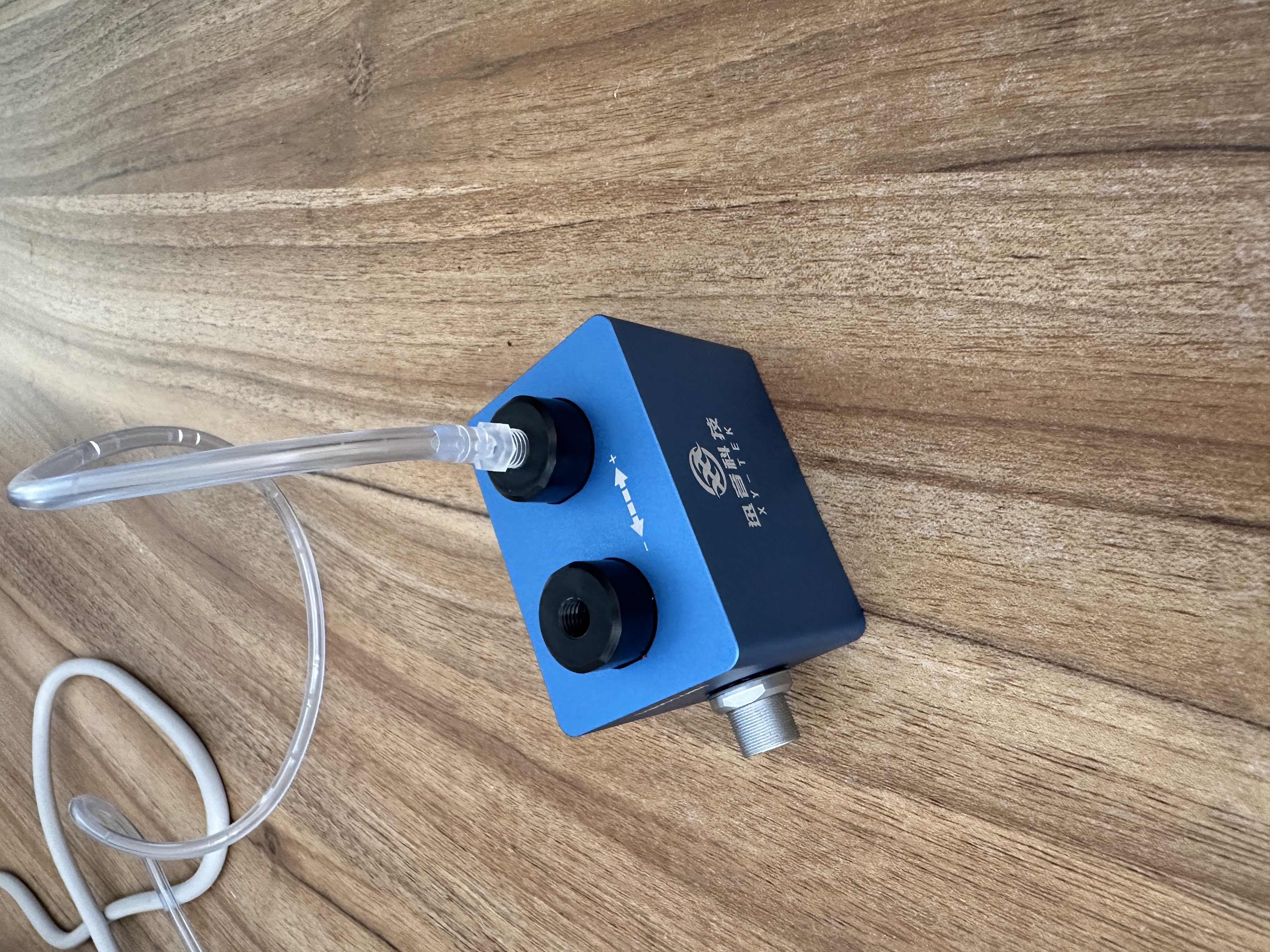
- Published accuracy: ±1%, with measurement accuracy up to ±0.1 mL/min
- Flow range: 0–1000 mL/min, with a measurement scope of 0.1–1000 mL/min
- Fluid temperature: 0 °C to 60 °C
- Body material: biocompatible plastic with ultrasonic sensor module
- Tubing compatibility: PVC, silicone, PFA, PE, PUR flexible plastic tubing
- Published target industries: bioprocess, medical equipment, pharmaceutical production, semiconductor
Here the evaluation consequence runs in the opposite direction. The TGU Series is a reusable instrument, and because it clamps onto the outside of the tubing, the fluid path is defined by the tubing set rather than by the sensor body. That changes both contamination control and changeover design — the recurring effort shifts toward handling and maintenance of a reusable device, while measurement resolution improves by an order of magnitude compared with the SU Series.
Where these two models sit in the wider XY-TEK range
The SU and TGU Series cover the two extremes, but they are not the whole portfolio. XY-TEK also builds the clamp-on CG Series for 0.02–20 L/min, the CM Series clamp-on flow meter for 0.05–30 L/min with RS485 output, inline TPD and TPK Series meters, the BG Series bubble detector, and the TH Series pulsatile flow sensor for cardiovascular and hemodynamic testing. If a bioprocess step falls outside both the SU and TGU windows, the wider range is usually where the answer sits.
Head-to-Head Comparison Table
| Evaluation criterion | SU Series (single-use) | TGU Series (reusable clamp-on) | What it changes in your decision |
|---|---|---|---|
| Sensor format | Single-use sensor with a disposable measuring channel | Reusable clamp-on sensor with a U-shaped measuring channel | Decides whether the sensor sits inside or outside the fluid path |
| Wetted materials | Biocompatible polymer materials | Biocompatible plastic with ultrasonic sensor module | Sets the material documentation package you need per project |
| Published accuracy | ±2% | ±1%, with measurement accuracy up to ±0.1 mL/min | Determines whether a step can be controlled or only trended |
| Flow range | 0.05–10 L/min | 0–1000 mL/min, measurement scope 0.1–1000 mL/min | Defines the overlap band: roughly 50–1000 mL/min sits inside both ranges |
| Fluid temperature | 0 °C to 60 °C | 0 °C to 60 °C | Identical thermal window, so temperature does not separate the two |
| Tubing / interface | Not specified in the published product data — confirm the fluid-path interface with the supplier | PVC, silicone, PFA, PE, PUR flexible tubing with smooth inner and outer surfaces | Determines whether existing tubing sets can be reused or must be re-specified |
| Published target industries | Biopharma, single-use systems, medical manufacturing, bioprocess | Bioprocess, medical equipment, pharmaceutical production, semiconductor | Shows where each design is already in service |
| Contamination control logic | Hygiene comes from disposability — the measuring channel is single-use and supports sterile application | Hygiene comes from separation — the sensor clamps onto tubing instead of entering the fluid | Choose the model that matches how your facility already controls contamination |
| Cleaning and validation burden | No reusable wetted channel to clean between uses | Cleaning and handling routines apply to the reusable device and its tubing interface | Moves recurring effort from cleaning cycles to consumable management, or the reverse |
| Cost-per-use structure | Recurring consumable cost per use or per batch | One-time instrument cost with recurring handling and maintenance effort | Compare against batch frequency and annual usage, not unit price alone |
| Installation | Integrated into the fluid path through the single-use set | Clamped onto compatible flexible tubing | Affects changeover time and operator training load |
| Best fit | Sterile, product-contact steps in single-use systems | Low-flow monitoring where resolution and reuse outweigh disposability | Use this row as the first shortlisting rule |
Step-by-Step: How to Run an SU vs. Reusable Evaluation
The following six-step sequence turns the table above into a defensible recommendation. It is written for engineers and procurement teams evaluating both formats for the same bioprocess line.
- Map the flow window for every step, not for the line. List the expected flow rate of each step in the same unit. The SU Series covers 0.05–10 L/min; the TGU Series covers 0.1–1000 mL/min (0.1–1 L/min). Steps below roughly 50 mL/min fall outside the SU range, and steps above 1000 mL/min fall outside the TGU range, which immediately narrows the candidate list.
- Decide whether the sensor may enter the fluid path. If the product is a sterile biologic and the facility already runs single-use assemblies, a single-use sensor with a disposable measuring channel and biocompatible polymer construction removes the wetted-component problem instead of managing it. If the sensor can stay outside the fluid, the clamp-on TGU Series keeps the tubing set as the only wetted element.
- Quantify the cleaning and validation workload per batch. For the SU Series, the workload is changeover of the single-use set and its documentation. For the TGU Series, the workload is the cleaning, handling and maintenance routine applied to the reusable device and its tubing interface. Compare the two counts per campaign, not per unit.
- Build the cost-per-use model around batch frequency. For single-use, multiply consumable usage by annual batch count. For reusable, spread the instrument cost across expected uses and add the recurring handling and maintenance effort. Changeover downtime and rejected-batch risk belong in both models.
- Validate with a sample on your own tubing and fluid. Repeatability is best judged on the actual tubing material and the actual liquid, particularly at low flow where bubbles and partial blockages distort readings. Compare unit-to-unit variation if the SU Series will be replaced regularly, and compare re-mount repeatability if the TGU Series will be moved between tubing runs.
- Confirm supply terms before finalizing the design. XY-TEK OEM and ODM programs start at an MOQ of 50 units with a quoted lead time of 1–2 months. Pre-shipment testing is 100% for OEM/ODM programs, third-party inspection is available, and after-sales coverage includes online engineering support, remote technical support and quality warranty.
Use Cases: Which Format Fits Which Bioprocess Scenario
In practice, most bioprocess facilities end up using both formats in the same building. The scenarios below show where the split usually falls, based on the published ranges and target industries of each series.
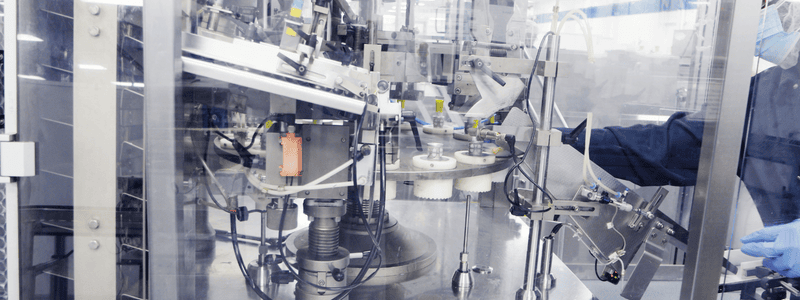
- Single-use media and buffer preparation (0.05–10 L/min): product-contact transfers where the fluid path is already disposable. The SU Series matches the existing hygiene logic — the measuring channel is single-use and supports sterile application.
- Perfusion and recirculation loops on flexible tubing (0.1–1000 mL/min): low-rate recirculation where resolution matters and the tubing is replaced independently of the instrument. The TGU Series clamps onto PVC, silicone, PFA, PE or PUR tubing and resolves flow to ±0.1 mL/min.
- Single-use seed train and sampling lines: small-volume transfers in biopharma and single-use systems, where batch comparability depends on replacing sensor units without losing repeatability. The SU Series specifies high measurement repeatability for this reason.
- Analytical and laboratory setups (millilitre-per-minute band): bench-scale work in bioprocess, medical equipment and pharmaceutical production environments where the same instrument is used across many experiments. The TGU Series keeps ±1% accuracy available on demand.
- Hybrid facilities: the common configuration is single-use sensing for sterile product-contact steps and reusable clamp-on sensing for utility, process-support and non-sterile loops. Matching format to step rather than to the whole facility avoids over-buying either consumables or instruments.
A practical rule that emerges from the published data: if the step is inside the overlap band of 50–1000 mL/min and the fluid path is disposable, the single-use format is usually easier to qualify. If the step sits below 50 mL/min, or above 10 L/min, only one of the two formats is inside its published range — and the comparison ends there.
Frequently Asked Questions
1. Are single-use and clamp-on low-flow ultrasonic flow sensors compatible with biopharma compliance requirements?
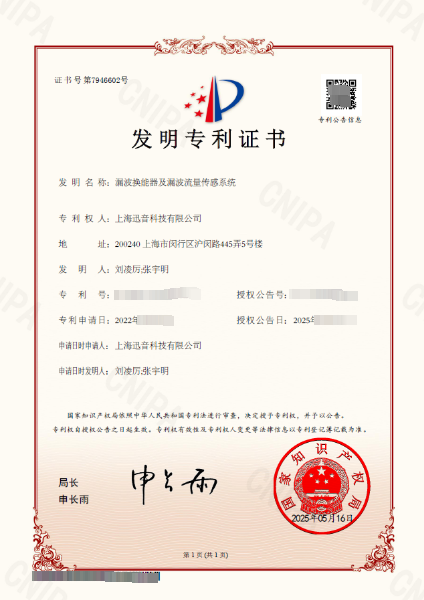
Both XY-TEK formats start from biocompatible construction: the SU Series uses biocompatible polymer materials, and the TGU Series uses biocompatible plastic with an ultrasonic sensor module. Two external frameworks typically enter the conversation. ISO 24062:2023 specifies requirements for clamp-on ultrasonic transit-time meters for liquids and gases in closed conduits, which is directly relevant to clamp-on formats. EN ISO 13485 applies as a quality management system for medical sensors, including flow sensors used in ventilators and drug delivery. On the manufacturing side, XY-TEK supports qualification work through 100% pre-shipment testing, third-party inspection on request, and online engineering support. The company also holds a China National Intellectual Property Administration (CNIPA) invention patent, No. 7946602, issued on 16 June 2025 and valid to 16 June 2045, covering liquid flow sensing and filter enhancement technology applications, along with two earlier CNIPA invention patents issued in 2022 covering ultrasonic flow sensor and flowmeter technology. Because documentation requirements are project-specific, confirm the exact document set with the supplier before qualification.
2. Can the TGU Series resolve flow at the millilitre-per-minute level, and how does the SU Series compare?
Yes. The TGU Series is specified with measurement accuracy up to ±0.1 mL/min and ±1% accuracy across a 0–1000 mL/min range (measurement scope 0.1–1000 mL/min), using a U-shaped measuring channel and compatible with PVC, silicone, PFA, PE and PUR flexible tubing. The SU Series is specified at ±2% across 0.05–10 L/min, with high measurement repeatability and a design intended for hygienic fluid monitoring and sterile application support. In short, the TGU Series is the higher-resolution option for very low flow, while the SU Series trades some resolution for disposable, product-contact hygiene.
3. How should we compare cost per use between a single-use sensor and a reusable one?
Compare structures rather than unit prices. For a single-use sensor, the recurring cost is consumable usage multiplied by batch or use count, with no reusable wetted channel to clean. For a reusable sensor, the instrument cost is spread across many uses, and the recurring cost shifts to handling, cleaning and maintenance effort for the device and its tubing interface. Add changeover downtime and rejected-batch risk to both sides. Volume also changes the commercial structure: XY-TEK OEM/ODM programs start at an MOQ of 50 units, with customization of sensor size, interface and logo printing under OEM/ODM, and customization of communication protocol and housing material under custom design. Because configuration drives pricing, the accurate comparison uses a quote based on your annual usage rather than a list price.
4. Can we test both formats before committing to a design?
Yes. Requesting samples is the standard way to validate low-flow measurement, because repeatability depends on the actual tubing material and the actual liquid being measured. A practical sample evaluation compares unit-to-unit variation for the SU Series — relevant when single-use units are replaced every batch — and re-mount repeatability for the TGU Series, which is relevant when the reusable device is moved between tubing runs. To arrange a sample evaluation or discuss which series fits your step, contact the XY-TEK team at global@xy-tek.cn.
5. What lead times and supply terms should we plan for?
XY-TEK quotes an MOQ of 50 units and a lead time of 1–2 months. Production windows are typically 15–25 days for OEM/ODM programs and 20–30 days for custom design projects. Quality control includes 100% pre-shipment testing for OEM/ODM programs, with third-party inspection available, and after-sales coverage includes online engineering support, remote technical support and quality warranty. For planning purposes, build the 1–2 month lead time into qualification timelines rather than treating it as a buffer.
Conclusion: The Decision Rule
The two formats are not competing for the same slot. They solve different problems on the same line.
Choose the SU Series when the sensor must live inside a disposable fluid path, when sterility and per-batch hygiene dominate, and when a 0.05–10 L/min range with ±2% accuracy and biocompatible polymer construction satisfies the measurement requirement. The advantage is that contamination control stops being a cleaning problem and becomes a design property.
Choose the TGU Series when resolution and reuse matter more than disposability — when the step runs at millilitre-per-minute rates, when flow needs to be resolved to ±0.1 mL/min with ±1% accuracy, and when the sensor can clamp onto existing PVC, silicone, PFA, PE or PUR tubing rather than entering the fluid.
When a step sits in the 50–1000 mL/min overlap band, the decision is no longer technical. It is a matter of batch frequency, cleaning and validation capacity, and how your facility already handles contamination control. That is the point at which a sample run on your own tubing and fluid resolves the question faster than any further specification comparison.
Next step: validate the format on your own process
The fastest way to close an SU versus reusable evaluation is to measure both on your actual tubing and fluid. XY-TEK provides sample evaluation support, OEM and ODM customization, and engineering guidance on format selection for bioprocess, medical and industrial applications.
Email: global@xy-tek.cn | info@xy-tek.cn
Tel: 86-21-33885752
Address: Building 7, No. 410 Jinggu Road, Minhang District, Shanghai 200245, China
Website: www.xy-tek.com
Have Questions or Need More Details?
Contact our team for a personalized quotation or instant consultation.
Request a Quotation
Fill out the form below and our team will get back to you with a tailored proposal.
WhatsApp Direct Chat
Prefer to chat in real-time? Message us on WhatsApp for instant assistance & quick answers.
- Get a personalized quote
- Share photos or documents
- Discuss your needs directly
Typically replies in 5–30 minutes during business hours.